Followers

Sunday, 22 May 2011

Nature walk with Jean Marie

16 friends and 5 dogs 9:30 on a this Sunday morning

A lovely warm sunny day

Friendships were made
Setting off at a good pace 

Are we almost there?


Breathtaking views

In the Viserny hills Dr Carre is buried with his horse

 Ouff its nice to sit down
 Mena
 Yummy more please !
Jean Marie' s old barn transformed for lunch
Mena and Mum 
 A digestive walk to admire Moutiers St Jean
 Jardin des Coeur du Roi
"Le Guide" at work 


Majestic staircase


This incredibly beautiful abbaye with corner gardens everywhere - let's turn it into a hotel !
 
 Marchand de vin - pity its closed !


Old stones and beautiful roses


Sunday, 15 May 2011

Fendi's week

It's that time of the year again: spring is springing in bounds and leaps, back and forth and roundabout. What used to be April weather now passes as March, at least in this neck of the woods. Elsewhere winter is still tightly holding on, while in other regions it never really settled in, in the first place. One of the most wonderful spring things to sprout at this time of the year (to my taste, anyhow), is wild asparagus. Regular cultivated asparagus bolts in May, but the wild variety pops up a little earlier. They are much daintier, but a delicacy nevertheless. Foraging for asparagus is not like ordinary foraging. It is more akin to mushroom hunting, for asparagus has a great talent to hide itself among the briars and bushes and often you won't see them at all until they are way too old and have started to sprout their feathery fronds. But once you have developed a 'nose' for the right season and the right places where the elusive spears might be found, hunting them down is an exquisite, fun-filled adventure, which may land you in some very strange places.
Asparagus likes to grow in a variety of places, depending on the species. Asparagus likes water, but not water-logged areas. It grows in well draining soil, near ditches or riverbeds and alluvial plains, where there is plenty of moisture nearby. It usually likes full sun, though some varieties also tolerate heavier soil and semi-shaded areas.
asparagus1 (39K)Although asparagus has a very distinctive appearance, it can be hard to spot.
Jean Marie found some wild asparagus in the forest.

We steam cooked them for 4 - 5 minutes and served them luke warm with a hollandaise sauce. 

Here is the recipe for a classic Hollandaise Sauce


7oz salted butter
2 egg yolks
2 tablespoons lemon juice
½ teaspoon fine grated lemon zest
2 tablespoons white wine vinegar
If you have unsalted butter, you can add a ¼ teaspoon salt to the sauce.You should not need to add any salt if the butter is salted but check the seasoning at the end anyway
All you need to do is assemble the ingredients and get your cookware together.

First, we need to melt the butter. This needs to be done five minutes or so ahead of time so that the milk solids can sink to the bottom. This is important for when we whisk in the butter as it allows us to control the consistency of the sauce.
hollandaise saucePlace a large pot filled to a third with water on to boil. Choose a stainless steel mixing bowl that sits on top of the pot but does not touch the water and place the egg yolks, lemon juice, zest and vinegar into the mixing bowl.
Turn the heat down to just under a simmer, this is the ideal heat and won't cook the yolks too fast. Sit the bowl over the water and gently whisk the yolk mixture in the bowl over the water and they will slowly start to heat and increase in volume.
Don't forget the purpose of the whisking is not to aerate the mixture so much as to avoid the yolks catching and also ensuring even thickening. You will notice the yolk mixture becomes a little thicker on the bottom and around the edges. Keep a towel around the outside of the bowl so that you can remove it from the heat if it starts to form lumps from heating too fast.
Keep the yolk mixture moving constantly by whisking continuously. You will notice the bubbles that form will get smaller and smaller and soon become the larger part of the yolk mix as the runny yolk cooks. The only thing that is important to remember at this stage is that if it starts to catch, lift the bowl above the pot to slow down the heating. In around five to ten minutes, the yolk mixture should be holding it's shape like a soft whipped cream and the texture should be as smooth. This means the yolks are cooked but not to the point of being scrambled and you have made yourself what is called in French cooking a "sabayon".
Sabayon can also be made with yolks and sugar. This is the base for many well-known recipes like parfait and semi fredo (parfait with a fair amount of alcohol like tequila added and served semi frozen). Often this technique is also used as a base for decadent cake baking.
Next comes the whisking in of the butter, make sure the butter is boiling hot. Place the sabayon bowl onto a damp cloth so it won't spin while you whisk. While whisking fast slowly pour on the butter keeping a steady stream of butter but keep the stream as thin as possible.   Bit by bit it will "take" and you have a wonderful fluffy, tasty sauce ready for your asparagus.


Meanwhile at the shop ...
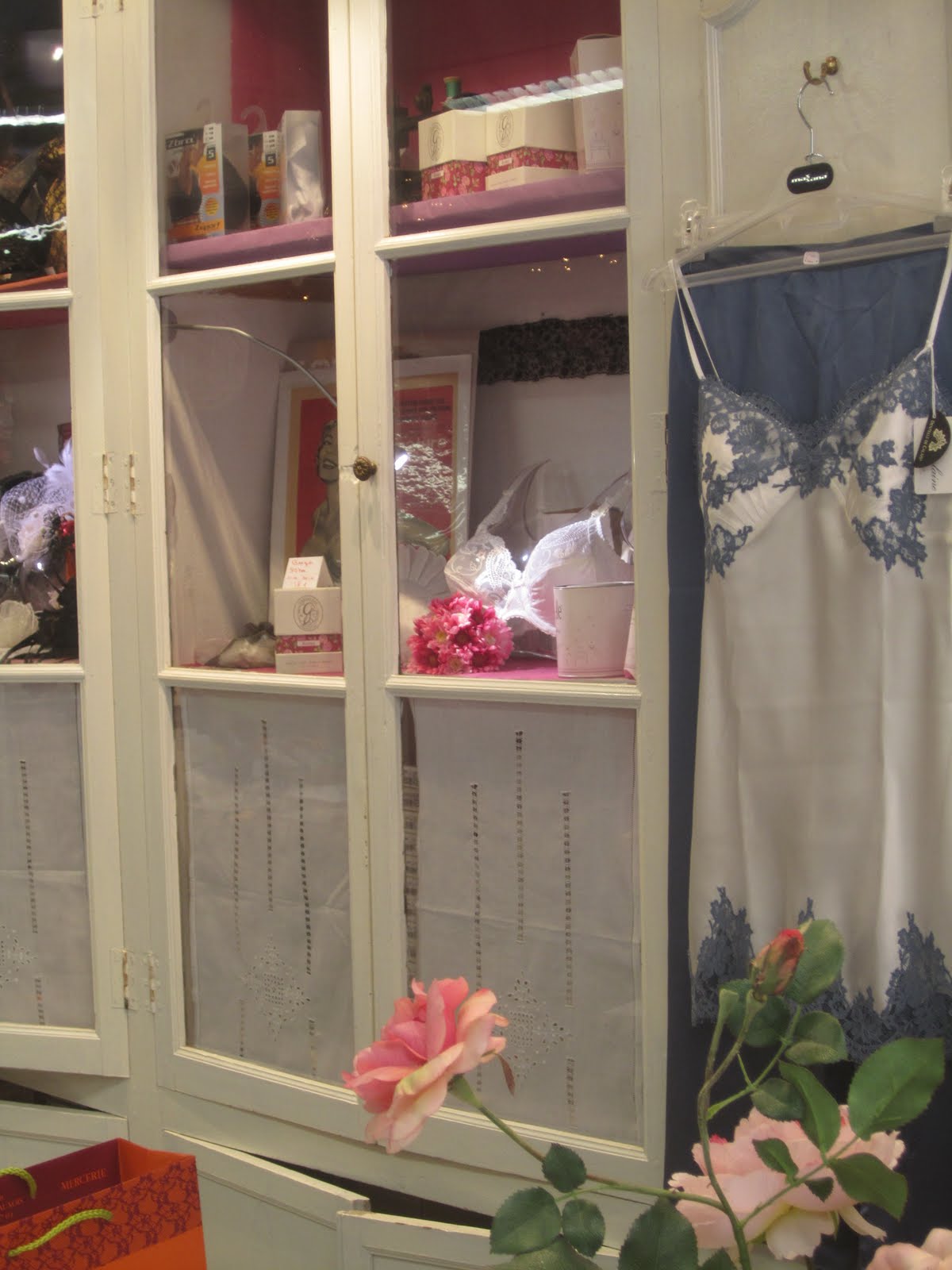
A beautiful blue and cream lace ensemble in pure silk hand made in Lyon by a wonderful company that makes very few items but each to exquisite perfection.

Lacy curtains show the courtyard in the throes of a "clean up".


Fendi eats everything in her reach - the asparagus were fascinating.  
She was resigned to sitting outside the shop and looking out for compliments.  She was inundated with people stroking her and saying how beautiful she was.    If I had 10 euros for each photo taken of her I would be a rich lady today !!

Monday, 2 May 2011

Good neighbours


The workers ;   HervĂ©, Jean Marie, Jacques, Vincent, Edouard, Gerard and Yves  all up at 7:30 on this Sunday holiday  morning to repair the next door neighbour’s  stone wall which had collapsed a few months ago.  The date for repair was set for the 1st of May traditionally a national holiday.   Stones were selected – measured and placed just at the right angle –ciment mixed to hold the joints.   Such solidarity is heart-warming to see.     This small village in Burgundy – about 150 people expanding to 180 during the summer months is a typical example French life.     Most young people have married and stayed on in the village either building their own house or restoring an old property belonging to their family.   So there reigns a lot of fellowship and camaraderie.   The “women” were invited to come over for the BBQ lunch and I arrived after having not done anything all morning.  Jean Marie’s barn

is at least 200 years old.


Was requisitioned - tables and chairs appeared


and we all sat down to a  feast.  The aperitif was the traditional “kir” which is redcurrant juice with white wine – small squares of patĂ© en croute, potato chips, pistaches, peanuts and home-made “merguez  sausages” which are made with porc or lamb and very spicy.   Chicken bits, pork chops and an amazing rice salad.     Epoisses cheese served at its best all runny and smelly  - several baguettes and good doses of red wine.      One of the kind wives had made little walnut cakes  to go with the coffee.   Then after this two hour break it was back to rebuilding the wall before all the cement dried.
What a wonderful way to celebrate May day.


Sunday, 10 April 2011

Turn a garden pest into a gourmet meal.


Today the 3rd of April it is raining –yippee the snails are out in force –  if you feel like spreading your toast with a few petit gris or vineyard snails, that is fine leave the big ones to cook up a  gourmet meal.


There are odd  laws in France and one particular to this country is concerning the precious edible escargot de Bourgogne (Helix pomatia )
Collecting or picking up snails with a diameter equal to or superior of  3cm. is strictly forbidden between the 1st of April till the 30th of June, which is the reproduction period of this gastropod.  A retired Gendarme,  oblivious to this legislation was recently sent before the judge for “ saving”  31 snails from a certain execution,  it wasn’t mentioned in the local paper  whether garlic and butter the essentials for cooking up escargots was found in his kitchen.
http://www.bienpublic.com/fr/article/4807620/Un-ange-gardien-au-tribunal.html(recent article in daily news)
Perhaps he was getting ready to prepare a very special beauty product as in Spain.  There it is very popular to use the slime from snails on your skin, because it's good for your peau.   First discovered at a snail farm in Chile it was found that the handlers had beautiful smooth skin compared with other workers.  
Snail slime has a whole bunch of stuff  that benefits your skin. One property is something called allantoin*.   The main benefit is that it promotes the faster shedding of dead skin cells to improve your overall complexion and make it brighter, prevent acne from forming, and it has anti-inflammatory properties.

First, we have to make the difference between snail slime and snail secretion. The slime is the fluid the snail uses to slide and that has no healthy quality for human beings whilst the snail secretion that can help delay skin aging and repair it, among other properties. Snails produce this secretion with the mere purpose to defend themselves from environmental aggressions.
It’s proven that legitimate snail products can produce a gradual reduction of fine and deep wrinkles, improve aged skin and hydrate it.  If you want to check up on this magical product I found this on the internet but admit to not having tried it myself.
(Fitosana Snail Cream - Baba de Caracol is one of the top brands of natural products in the world, the product is made with the best Helix-Aspersa extracts and manufactured under the highest quality standards.)  

So whether it be for beauty reasons or a feast – let’s hope it rains on the 1st of July.
 Vive la France Vive les escargots.
*
Allantoin is a chemical compound naturally produced by many organisms, including animals, plants, and bacteria. It is a frequent ingredient in lotions and skin creams, as well as in oral hygiene products, cosmetics, and other toiletries. Allantoin is also used in medications for dermatological conditions including acne, impetigo, eczema, and psoriasis. It is effective at very low concentrations, usually from 0.1% to 2%.

Sunday, 3 April 2011

Nature is the best bleacher


A client in tears yesterday at the shop.    After months of embroidery labour, every stitch carefully and painstakingly finished,  loving thoughts into each push of the needle -  visions of a beautifully set table for a special occasion - a tablecloth for her grandchildren - first time in use a green candle was spilt over her hard work.    My dear friend Michelle in the shop at the time saved the day by giving her this tip:

When you have a stain on your tablecloth whether it be red wine, oil from salad dressing or pot grease.
Before washing in a machine - pour ordinary washing-up liquid over the stain - rub in with hot water and small brush to massage it in thoroughly.   Let it soak in for 15 minutes and then machine-wash as normal.
If, as in this case, it is candle wax.   Harden the wax by rubbing with ice. Remove the surface wax by carefully scraping with the dull edge of a butter knife, if that doesn't work, you can try the next suggestion. Sandwich the wax stain between folded paper towels and press down lightly on top of the towel with a warm (not hot) iron. Replace the paper towels frequently to absorb more wax and to prevent transferring the stain to new areas. Continue as long as wax is being removed.
 If you have a old yellow stain on your tablecloth,  I have found that nature is the best bleacher. Hanging tablecloths from a clothesline or laying it outside on a sheet in the grass after washing will do a beautiful job of lightening these stains. Make sure that if you hang your tablecloth on the clothesline, you are not stretching the ends. Use several clothespins to hang it straight across the line.
Sunshine a natural cleaner.

Buch 110 Schmetterlingszauber Embroidery kits from Rico at l'Aiguillée-boutique.

Sunday, 27 March 2011

“le gourmet mĂ©decine” or health Ă  la Française

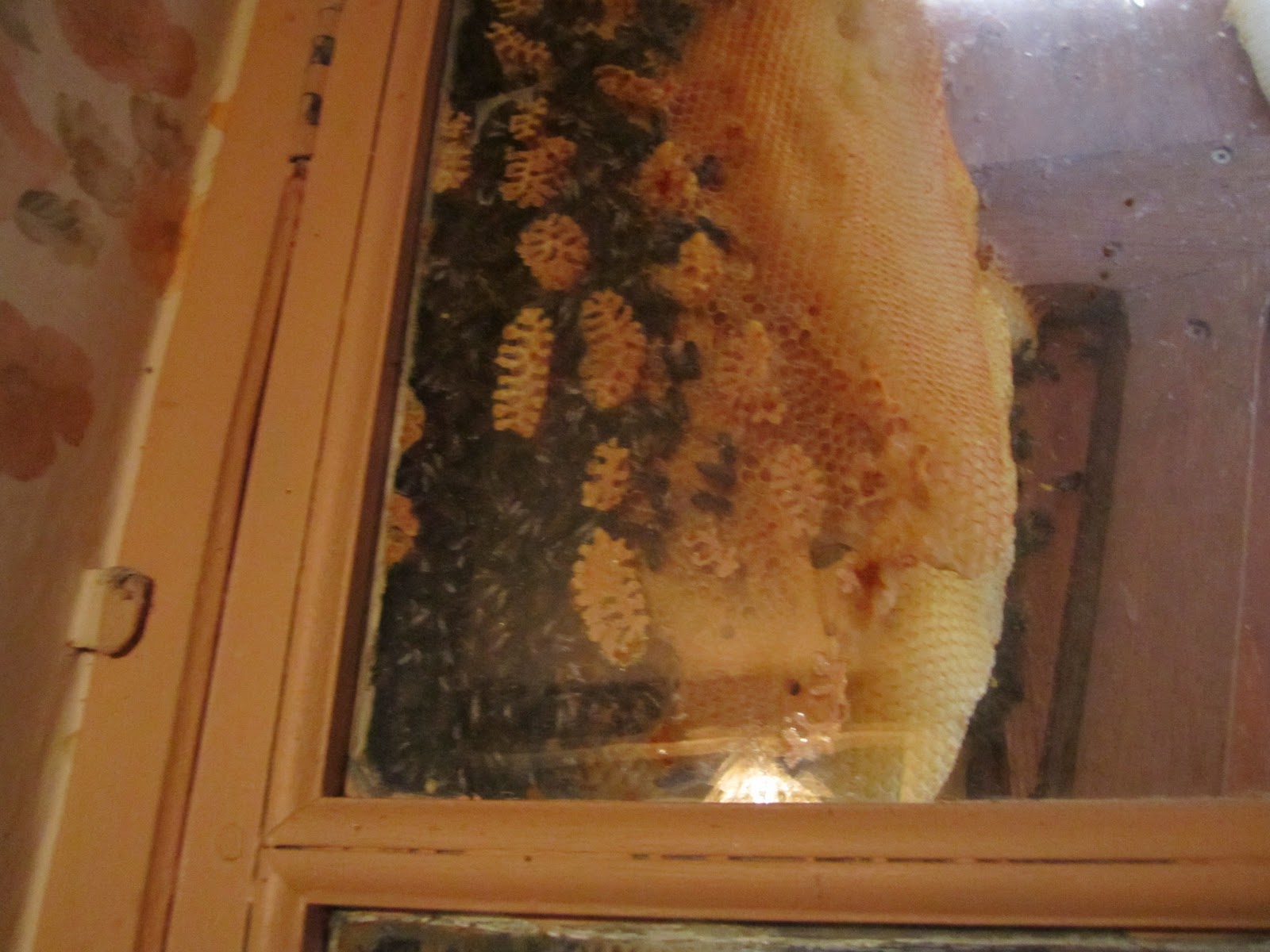
Jean Marie’s next door  neighbour  has gone into a nursing home but her house has never been so full in fact it is buzzing with activity.   In her absence the première Ă©tage has become  a thriving factory – a noisy throbbing place where ouvrières work non-stop all day tending a royal bed, visiting, gathering nectar, searching for pollen and defending their group.   Yes, there is a beehive established  between window and shutter in the bedroom.   This room faces South so it must be reaching boiling point in the hive.  A very unusual place for bees to build their "home".  Most often they are attached to a tree or in a chimney.
These “busy bees”  enlist a highly specialized caste system as they are incapable of living and working alone  - the survival of  the colony is vital.   Each member of this community fulfills a need that serves the group. Tens of thousands of workers, all underdeveloped females, assume responsibility for feeding, cleaning, nursing, and defending the network.   Male drones don’t have a great life – as their anatomical structure proves a limited role  - they do get to mate with the queen, but the pleasure is short lived as they die immediately afterwards.
Amazing and thrilling to be able to get close to the window and see “into” a hive.   My photos with full sun on the outside don’t give justice but good enough to imagine though.   Here is what we found :


Is honey good for you?   It is not only good for you; it is amazingly wonderful for you, for all of us.
Honey or as the French call it “le gourmet medicine” has extraordinary powers. Offering incredible antiseptic, antioxidant and cleansing properties for our body and health,  amazing healing properties from eye conjunctivitis, indigestion, and  psoriasis to athletes foot.   Honey contains almost every vitamin, mineral and essential ingredient including water we need to sustain life and keep us healthy.

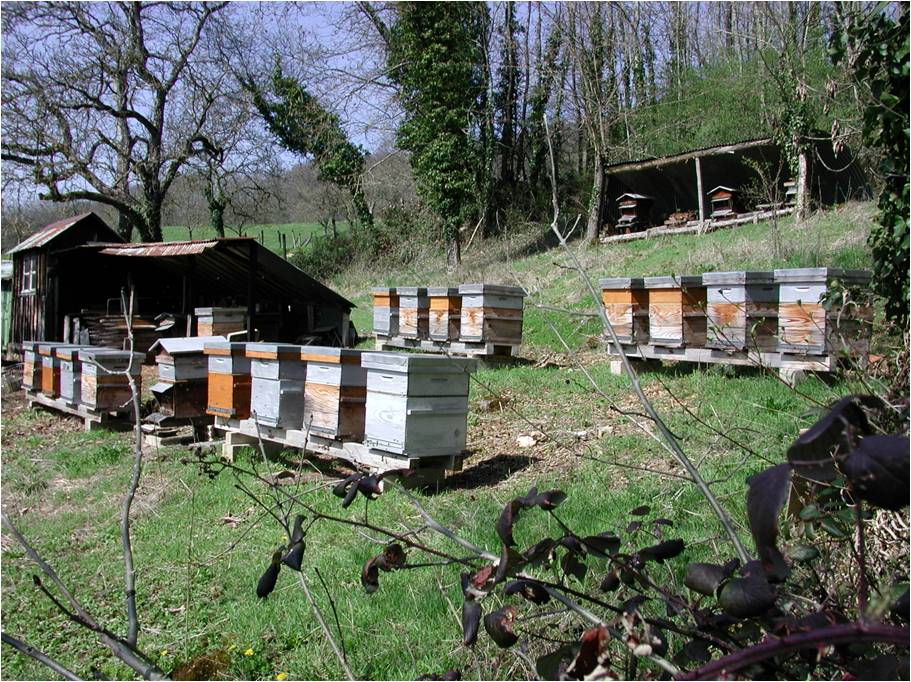
Monsieur Durand sells me his honey every market Sunday. Vue sur les Rucheshttp//:rucherdefontenay.free.frPanorama

  He has been instructing me on les “bienfaits de son miel” with 200 ruches or beehives he owns.
Try taking honey with your tea or that all time favorite a warm glass of lemon and honey to treat that irritating cough and cold or eat it straight from the jar, delicious!
Honey also lubricates the throat, calms everything down and helps to induce our all important sleep. Many famous singers know the benefits of honey for the throat and generally gargle regularly with this to help save their voices.


Healing honey used in conjunction with cinnamon is fantastic for relieving the sometimes insufferable problems brought on by the woman’s menopause, buckwheat honey can also be very helpful for this natural but annoying process.
Please don’t reach for the cheapest jar on the shelf or the one that looks the prettiest as this type of honey is NOT honey, it’s a fake and one that bee keepers refer to as “crankcase oil”.


You wouldn’t dream of buying rotten eggs, fruit, meat or vegetables or any kind of rotten food produce so don’t be fooled into buying those kinds of honey.
 
If you take the time to read the labels on honey jars you will easily be able to discover if it is a good honey or not.
If there is nothing added to the ingredients in the jar, it is just pure honey and this is the best you can buy.
Along with your jar of honey I advise very strongly for you to keep a supply of some kind of cinnamon supplement in your store cupboard which will help to form the basis of your newly discovered and completely natural medicine supply.
Honey and cinnamon In Chinese medicine cinnamon means “warm herb” warming our energetic channels which help to warm our bodies and greatly improve our circulation.)


For Dry Skin: Avocado & Honey Face Mask
You will need:
2 tablespoons of avocado flesh
2 tablespoons honey
1 egg yolk
To form this anti aging skin care face mask, put all the ingredients in a blender, or mash by hand in a bowl. Use your fingers to spread the mask over your face and neck and leave it on for at least 30 minutes.  Rince carefully and apply your usual moisturizer  - wow!  you look beautiful.


slathered with some honey (posted by "anonymous"

What is this you say?  This is a Calabaza - to you a Pumpkin.  This is half, bought by me from our local Panaderia (Bakery) which is around the corner from where we live.  It is delicious.  I had seen it many times on the shelf but never thought to buy one.  Of course, after tasting it for the first time I have been back on several occasions!  The baker, when you think of it, has the perfect opportunity to put some Pumpkins into his ovens.  The ovens are fired up early morning and he bakes all his bread and then he can put the pumpkins in  - slathered with some honey - and they slowly cook away to their heart's content.

The ladies in the bakery think of it as a sweet or dessert and the lovely soft pulp can be utilized in pastries of various types.  However I have wonderful memories of a pasta called Mezza Luna which we had in San Francisco once and which I have never forgotten. The calabaza was in a home-made ravioli with sage in the shape of a half-moon (mezza luna)... delicious. 
I, on the other hand, have only used it as a side vegetable dish so far and am grateful that it is just around the corner!


What is this you say?  This is a Calabaza - to you a Pumpkin.  This is half, bought by me from our local Panaderia (Bakery) which is around the corner from where we live.  It is delicious.  I had seen it many times on the shelf but never thought to buy one.  Of course, after tasting it for the first time I have been back on several occasions!  The baker, when you think of it, has the perfect opportunity to put some Pumpkins into his ovens.  The ovens are fired up early morning and he bakes all his bread and then he can put the pumpkins in  - slathered with some honey - and they slowly cook away to their heart's content.

The ladies in the bakery think of it as a sweet or dessert and the lovely soft pulp can be utilized in pastries of various types.  However I have wonderful memories of a pasta called Mezza Luna which we had in San Francisco once and which I have never forgotten. The calabaza was in a home-made ravioli with sage in the shape of a half-moon (mezza luna)... delicious. 
I, on the other hand, have only used it as a side vegetable dish so far and am grateful that it is just around the corner!


Our stories

Why did you lie to me

Annemarie's story Why Did You Lie to Me? You told me angelica (which I loved) was candied celery - so that I would...